Working in cycling was never the dream for Daisy Zorzo, indeed when she was a teenager she dreamed of being a dancer in a Beyoncé video.
While becoming a backing dancer for Beyoncé never materialised, working in the logistics department of a cycling team turned out to be the dream job she hadn’t known she wanted.
“There were several eras but the one I remember the most was when I wanted to be a dancer in one of Beyoncé’s videos. It was a silly dream because I like dance but I’m not a super talent,” explains Zorzo.
“When I was in high school, I also told myself that I wanted to work in an environment with people from around the world and speaking different languages. Today I can say, this job is the one that looks like most what I thought of when I was dreaming in high school.”
How she became GreenEDGE Cycling’s logistics manager is a story of chance, and taking an opportunity when it came. She didn’t study logistics or planning – at university, she studied media and communications as well as economics – but it was something she enjoyed doing.
Zorzo grew up in Albizzate, a small Italian town an hour north of Milan, with one older and four younger sisters. As a teenager, she joined a group of fellow young people who put on events for the locals and eventually became part of the organisation’s committee. From beer to music festivals, Zorzo gained a wealth of experience in logistics.
“We had some international bands that performed at it one time, and we had a lot of fun organising this,” she says. “It was the very first experience I had in my life where I was working for something. I would organise selling the tickets or paying the people who arranged the stage, the singers, the bands, and things like that.”

After leaving university, she ended up working for a private medical company for a time and then another company that designed laminators. The jobs weren’t what she really wanted to do and she started looking around for something new.
While having dinner with a friend who she knew from her local organisation committee days, Zorzo mentioned her desire for change and that she hoped to find something that allowed her to meet people and become involved in organising again.
A month later, while she was on holiday, her friend called and said the company his best friend was working for needed someone and she could be the right person for the job. The best friend happened to be Jacopo Scampini, GreenEDGE Cycling’s head of service course.
“I said ok let’s try, why not. I didn’t know where I wanted to work, but I wanted to find somewhere that was multicultural with a lot of things to do and organise. This job is, in the end, the thing that I was looking for,” Zorzo says.
A new challenge and new beginnings
After a couple of interviews, Zorzo joined GreenEDGE Cycling in 2022. The learning curve was steep, but she was happy with her decision.
“Now, my fourth year is starting, and it feels like only yesterday that was my first day here. I know now that taking this chance was one of my best decisions in my life. Sometimes I’m very tired, but I’m also very happy because I know I arrive here and there are situations that we can solve.”
One of the many things that Zorzo must “solve” is how to get the more than 150 GreenEDGE Cycling riders and staff members around the globe to take part in hundreds of days of racing across the season. Having come from a more regular 9 to 5 job, it was an eye opening experience to begin with.
“People are travelling so much, it’s like they live on the road sometimes. I was curious about who has got family and kids and it was surprising that it can work, and in a very good way from what I have heard from my colleagues,” Zorzo explains. “This job never stops, there is no Monday or Sunday, there is another calendar. Coming from a very traditional industry, it was a private medical centre and it was very standard, this was a surprise.”
A travelling circus
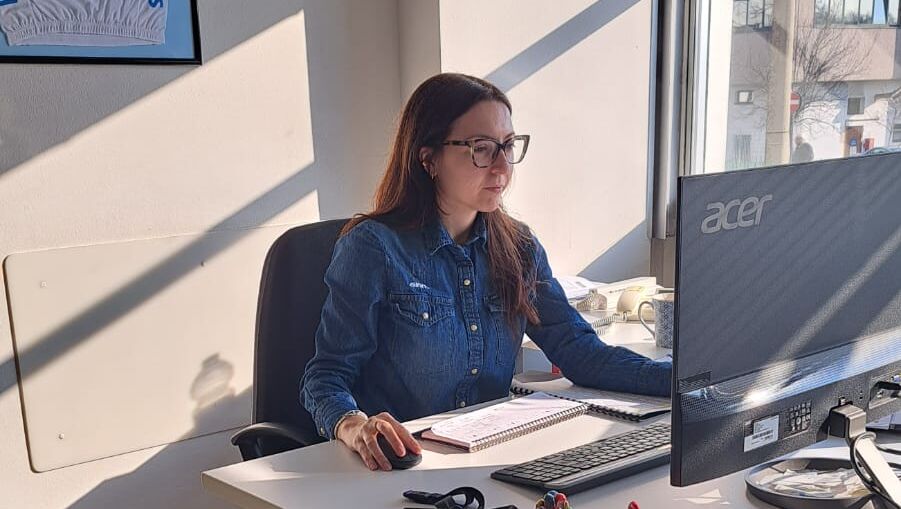
Zorzo is not alone in her role, and she works closely with logistics coordinator Francesca Vescovi, and team coordinator Vittorio Algeri. A picture of Algeri in his days as the amateur Italian road race champion is taped onto the whiteboard behind her desk at the team’s service course in Italy.
Getting the team to races is something of a juggling act, with vehicles, materials, and airport pickups forming part of a larger act. “It’s like a circus that moves, or a singer that has to do a tour,” she says.
Grand Tours require the most resources and planning ahead of time, but it’s events like the Classics that provide the most headaches with riders and staff coming in and out all the time. Zorzo and her colleagues are in constant communication with organisers in the build up to the race, filing paperwork, submitting kit and rider images for the race website, staff profile pictures for accreditation, arranging visa documentation for the flyaway races, and much more.
Then there’s the flight plans to make sure everybody gets to the first race hotel, but perhaps the nearest airport is a two-hour drive so further transport needs to be considered.
“For instance, you have to go to the Tour de France, and within a day of each other, you and everyone else has to be at Charles De Gaulle. Maybe a mechanic is coming to the service course because he has to drive a truck, no problem, I book a flight for him and he will arrive here, but then he needs somewhere to sleep. But then actually, I don’t have to book a flight because in Spain there is a car that needs to be brought to the service course.”
Before the riders and staff arrive at a race, who rooms with who has already been decided. Aspects such as vehicle parking, positioning of the rooms within the hotels, food allergies and more needing to be discussed with all of the hotels ahead of time, too – a hefty number when you consider the month that the team is on the road for Grand Tours.
“The hardest part is the hotel list. You have to pay attention to requests like someone needing a single room, and you can’t put two soigneurs together because they need the space for the table for treatments,” Zorzo explains.
“You have to contact each hotel with the rooming list, and with the request of being at a lowest floor possible with rooms close together if possible, and ask if they can save a place in their parking because we have a lot of vehicles. This is tricky, especially because sometimes the hotel list doesn’t arrive until quite close to the race. Maybe you get some hotels that are very far away and you need to find a new one but it’s already quite close to the race. Then there are also requests for guests.
“You have to do it alongside the other races that are going on. You cannot say now I do this, and I don’t look at anything else, because you lose time or you miss something.”
When the staff and vehicles roll out of the service course on their way to a new race, Zorzo can breathe a sigh of relief that the toughest part is over. The next one may be swiftly incoming, but it is a moment of satisfaction that this one has been arranged.
“When they leave and I see the bus and the cars going, I can relax a little.”