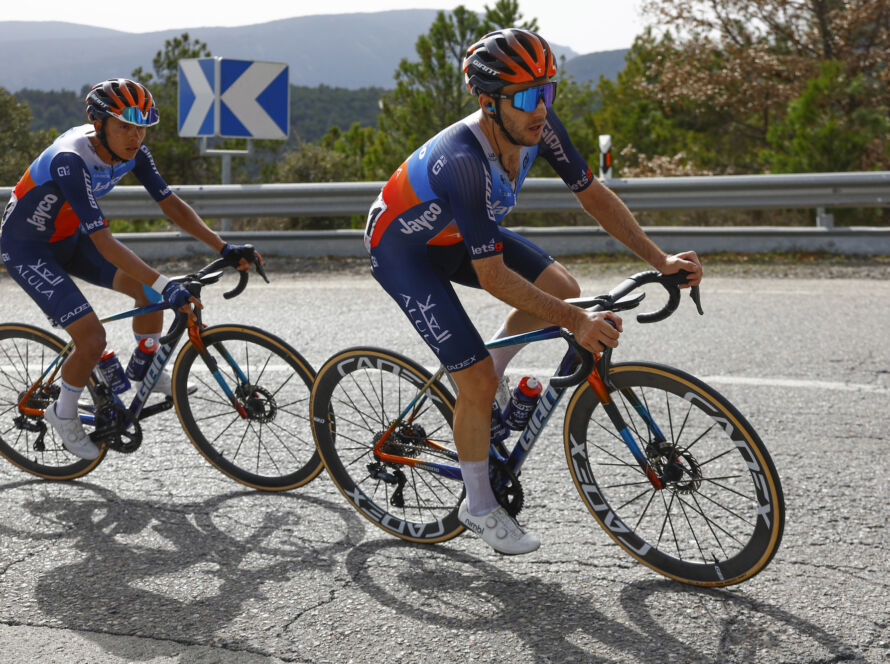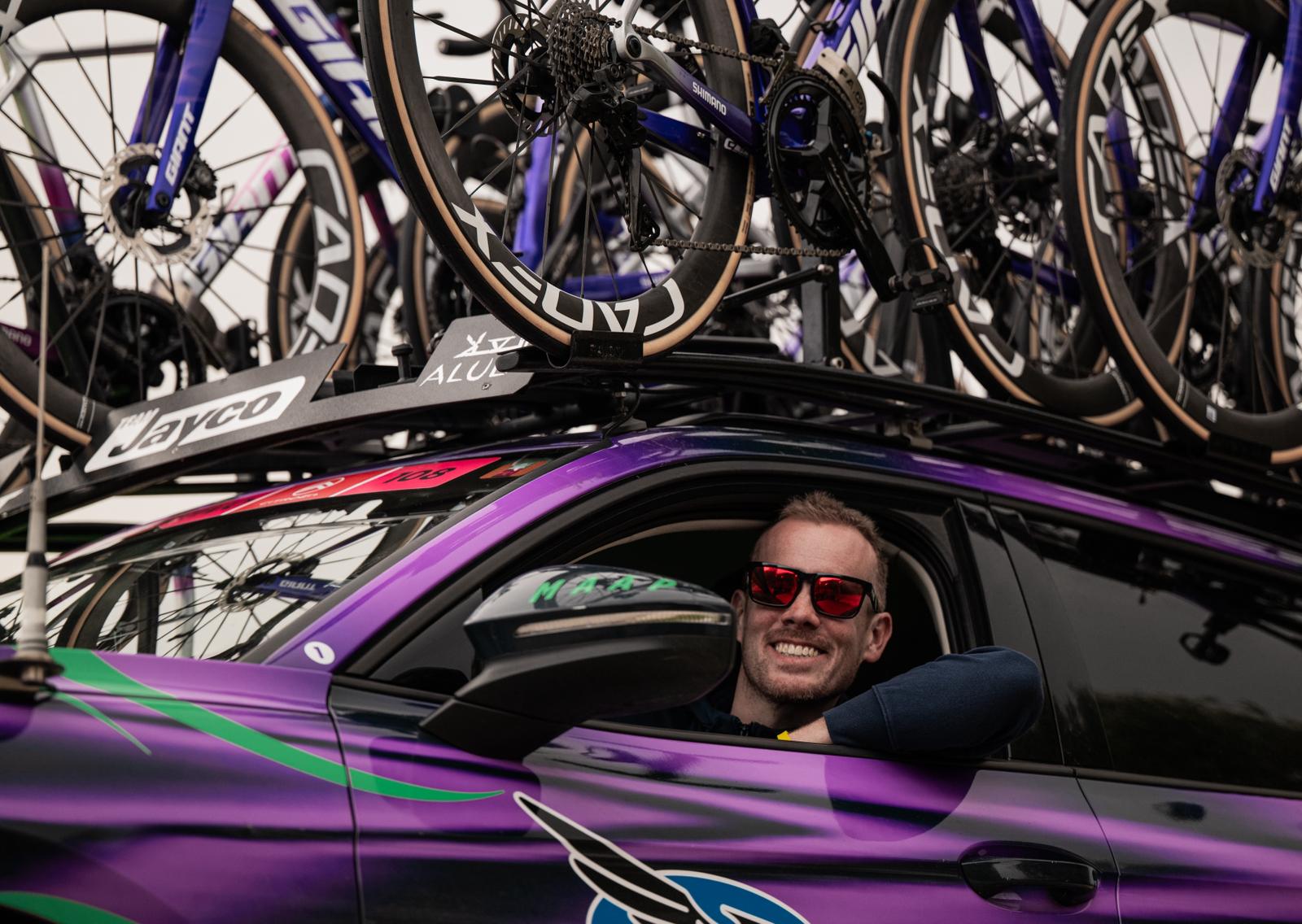
“After finishing the first stage of the AlUla Tour, I went back to the hotel and said to myself, ‘You made the right choice.’ I couldn’t wait to get in the car the next day,” says Alessandro De Marchi.
The Italian former professional rider, who turns 40 this year, has been competing in his first races as a sports director for Team Jayco AlUla in recent months.
His was a long professional career: 15 seasons, including victories at the Tour de France, the Vuelta España, and two days in the pink jersey at the 2021 Giro d’Italia. His debut as a sport director was in Saudi Arabia at the end of January, before competing in several races in Italy, including Strade Bianche and Tirreno-Adriatico in March.
On the eve of the final stage of the ‘Race of the Two Seas’ he talks about how he continues to discover new aspects of his job. “Tirreno,” De Marchi explains, “has become a great testing ground, with a real routine. Maybe it’s because it’s my first WorldTour stage race, but the pace is really intense.”
Learning by doing
There are many things to know and adapt to in his new role and De Marchi’s new life is a continuous “learning by doing”. His experience as a former pro rider is helping him, but what’s new is the great sense of responsibility he feels toward the riders.
“You’re in the race to help them by giving them as much information as possible. After all, you can’t do much from the car, and for that very reason, even with that little, you have to be timely and super precise. You can’t afford to give imprecise and incomplete information.”
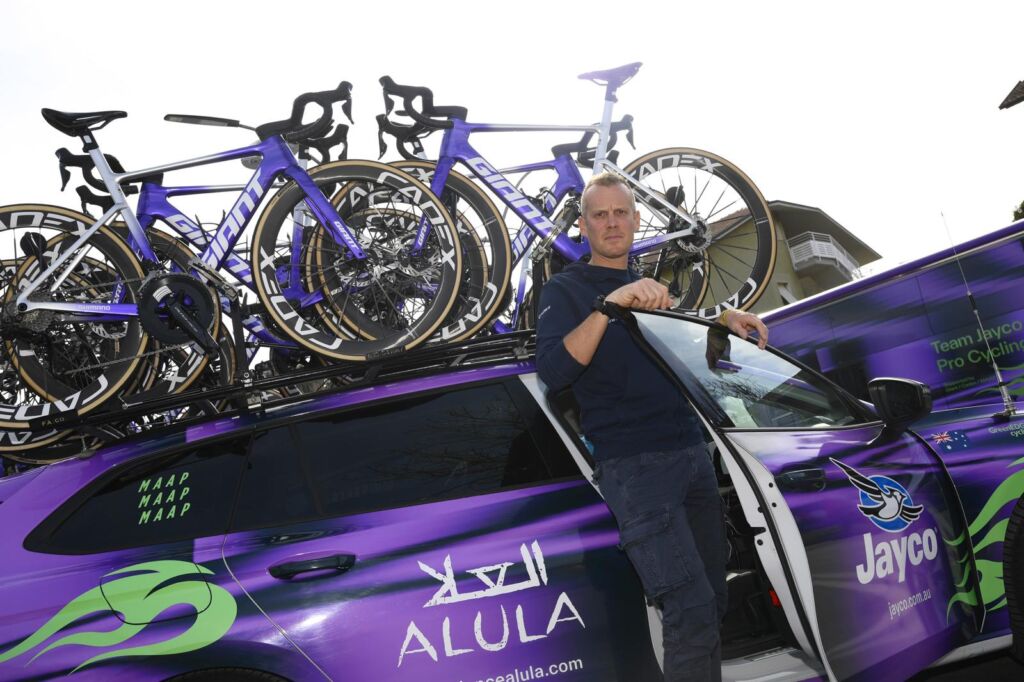
He’s also perfecting his driving, a key part of being a sport director. “I’m learning that you have to be relaxed and confident while driving, otherwise you risk hurting someone,” says De Marchi.
During the race, there can be moments of great confusion, but generally, a professional rider knows how to behave in a race.
“When you hear a horn, you know something’s happening behind you. Maybe a rider is coming, or a car wants to overtake you; that’s the most complicated moment,” he says. “Compared to my generation, the younger riders are a little more undisciplined; sometimes they move in the group differently than you expect. You need to be very careful.”
Preparation is essential
A typical day for a sports director doesn’t have much downtime. You leave the hotel by bus for the start, race meeting, team presentation, radio checks, and then the stage begins.
“Normally, race directors prepare for the race in the afternoon [before the race],” explains De Marchi, “and send the presentation to the riders for any comments.”
The day before, logistics must be ironed out, including feed locations, who does them and what goes in each bidon. The following morning, the PowerPoint presentation is completed. If there have been route changes or weather changes, they must be updated. Then the race meeting begins, which can last 20 to 40 minutes, depending on the type of stage. There’s a lot to do at the start location. After the race, on the way to the hotel, the stage debriefing takes place, and then everything starts again.
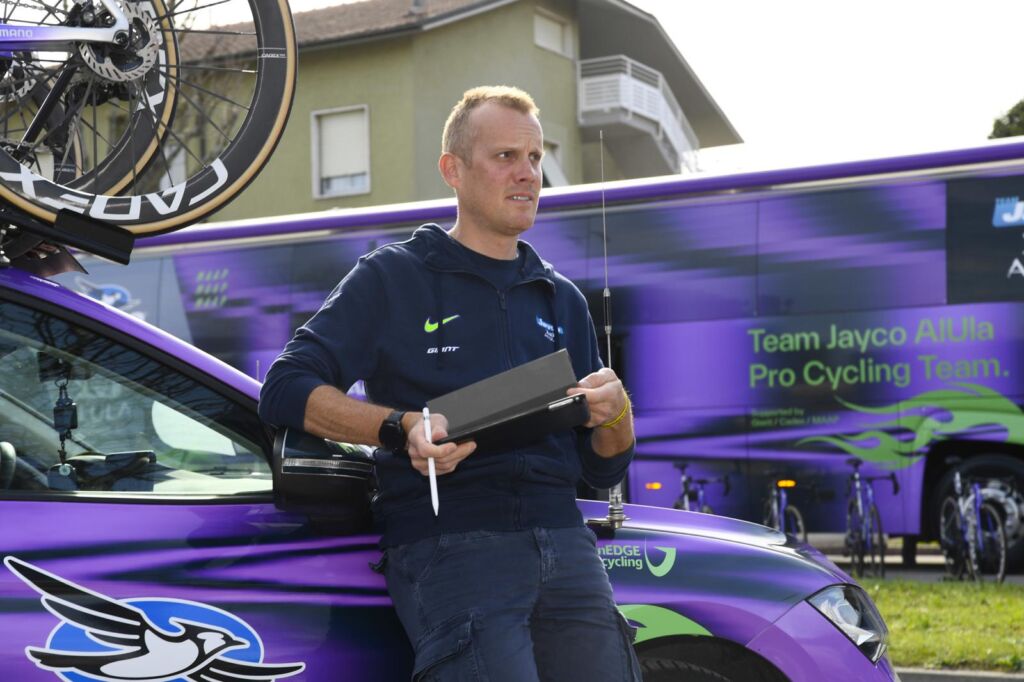
“Time is really limited, so it’s crucial to prepare for the race when you’re at home. You have to study each route in detail – the team uses an app called ‘VeloViewer’ – to get to know it blindly. In some cases, you go and reconnoitre the points that seem more complicated, and then you have to take into account the wind, the weather, and the type of road.”
Talk to the Riders
A good sports director must talk to the riders. For De Marchi, communicating with the athletes and staff is crucial. “There’s not much free time,” he emphasizes, “and I want to use the little time I have left to talk to the entire team, starting with the riders.”
The morning meeting before the start is a good opportunity for discussion, but it can’t be the only one. “I like talking to the athletes in the days leading up to the race and then spending each evening in their rooms to exchange impressions of the day and discuss goals for the following day.”
For the Italian, feedback from the riders is essential, as is maintaining a strong relationship between sports director and athlete.
“What I’ve learned from my experience,” De Marchi continues, “is that sometimes just talking and exchanging opinions solves many problems and allows the rider to give their best.”
New knowledge
De Marchi will return home from the Tirreno-Adriatico with new knowledge. For the first time, he drove the second car, which usually takes the lead, the one that goes ahead of the peloton up to the first feed zone – usually in the first 50km of the race – and relays any useful information to the first car.
After the feed zone, the second car lines up behind the bunch. “When I see a rider in trouble,” De Marchi smiles, “I think back to when I was in trouble too, and I usually help them even though I shouldn’t. Sports directors usually help each other, even though there are moments where competitive fury prevails and there’s a bit of a battle between the cars.”
This is just the beginning for De Marchi and there’s plenty more to look forward to and glean from in the season ahead.
“For me, it’s like starting from scratch,” he says. “It reminds me of my first year as a professional, when I didn’t have any specific expectations, but was ready to experience every race as a chance to learn as much as possible.”
For this reason, he’s very happy to have a very varied race calendar, starting with the AlUla Tour and the races in Italy, as well as races such as the Belgian Ardennes classics and the Vuelta España. Step by step.
Top photo: @pocispix